4. 2019 Halloween Storm
The 2019 Halloween storm stroke the eastern U.S. cities with wind gusts, thunderstorms, and flash flooding.
4.1. Model Configuration and Datasets
The UFS Medium-Range Weather (MRW) Application (App) is used to prepare initial conditions, compile and run the UFS model, and post process the raw model outputs. Two model configuration compsets (GFSv15p2 and GFSv16beta) are tested using the C768 (~13km) spatial resolution with 64 vertical levels (default).
The case runs are initialized at 12z Oct 25, 2019 with 120 hours forecasting. The corresponding namelist options that need to be changed are listed below. The app uses ./xmlchange to change the runtime settings. The settings that need to be modified to set up the start date, start time, and run time are listed below.
./xmlchange RUN_STARTDATE=20191025,START_TOD=43200,STOP_OPTION=nhours,STOP_N=120
Warning
The model run time step is reduced from the default 225s to 150s in this case due to the model instability in GFSv16beta. To set the time step, add dt_atmos=150 to user_nl_ufsatm
Initial condition (IC) files are created from GFS operational dataset in NEMSIO format. The GFS reanalysis dataset are used as ‘truth’ to compare with simulation results.
The GFS model EMC global workflow points to the most up-to-date GFS model development code. The GFS.v16.0.10 is tested in C768 (~13km) resolution and in 128 vertical levels. It uses two scripts, setup_expt_fcstonly.py and setup_workflow_fcstonly.py to set up the mode simulation date and case directories.
The case runs are initialized at 12z Oct 25, 2019 with 120 hours forecasting. The settings that need to be modified to set up the start date and directories are listed below.
./setup_expt_fcstonly.py --pslot 2019Halloween --configdir /PATH/TO/YOUR/GLOBAL/WORKFLOW/parm/config --idate 2019102512 --edate 2019102512 --res 768 --comrot /PATH/TO/YOUR/EXP/DIR/comrot --expdir /PATH/TO/YOUR/EXP/OUTPUT/expdir
The account and simulation duration time can be set up in /expdir/2019Halloween/config.base file.
./setup_workflow_fcstonly.py --expdir /PATH/TO/YOUR/OUTPUT/expdir/2019Halloween
Next step is to go to /expdir/2019Halloween to submit the run by
crontab 2019Halloween.crontab
4.2. Case Results
4.2.1. Synoptic Dynamics
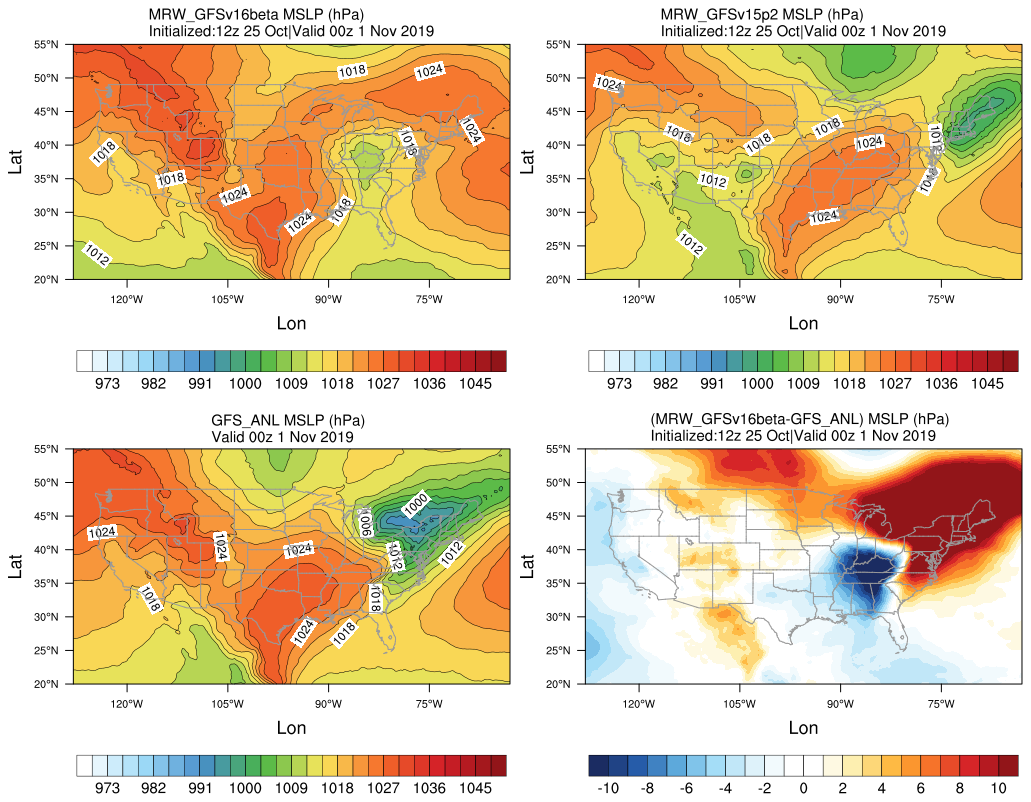
Mean sea-level pressure (MSLP, hPa)
MRW_GFSv15p2 simulates the sea level pressure structure more reasonably than MRW_GFSv16beta.
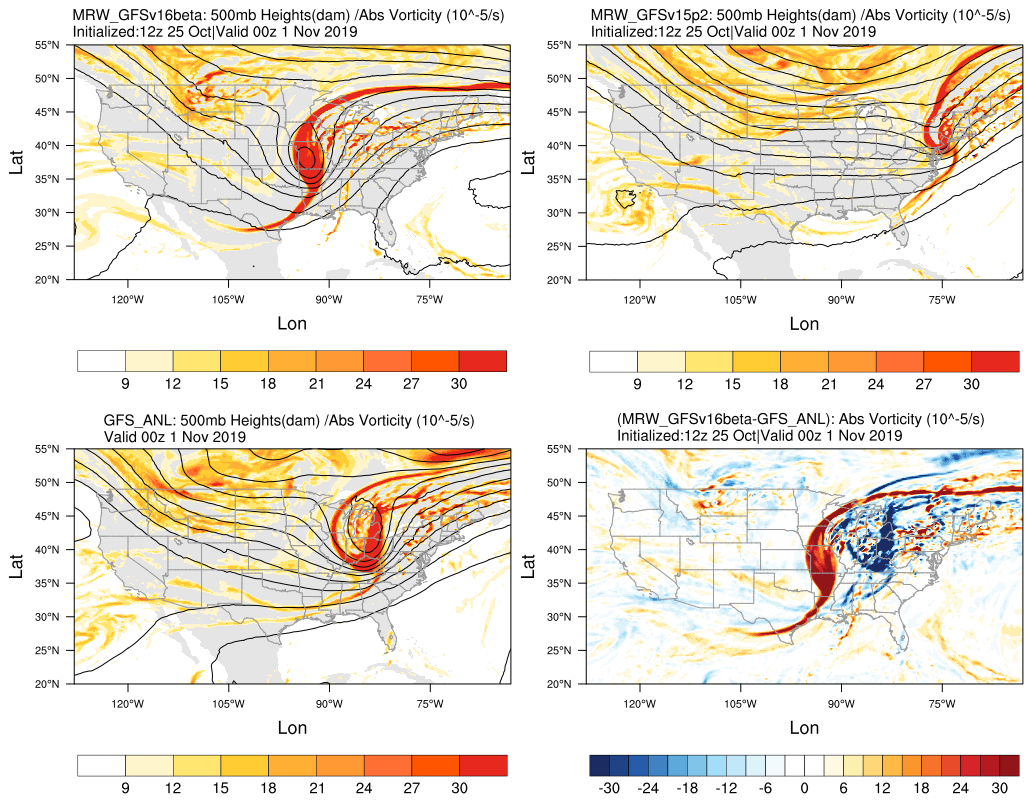
500 hPa geopotential heights (dam) and absolute vorticity (10 -5/s)
MRW_GFSv15p2 generates a progressive synoptic pattern compared with reanalysis data.
MRW_GFSv16beta alleviates the progressiveness of synoptic pattern.
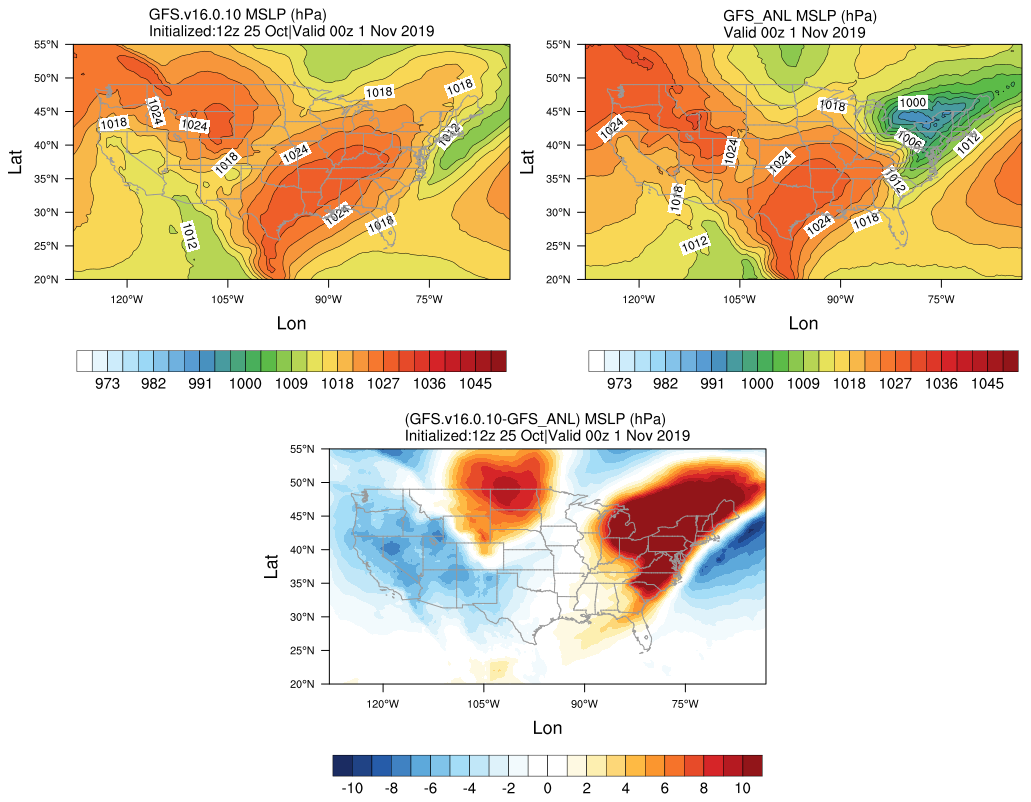
Mean sea-level pressure (MSLP, hPa)
The strength of sea level pressure gradient is weaker in GFS.v16.0.10 over the Northeastern U.S.
Higher sea level pressure controls the U.S. east coast in GFS.v16.0.10.
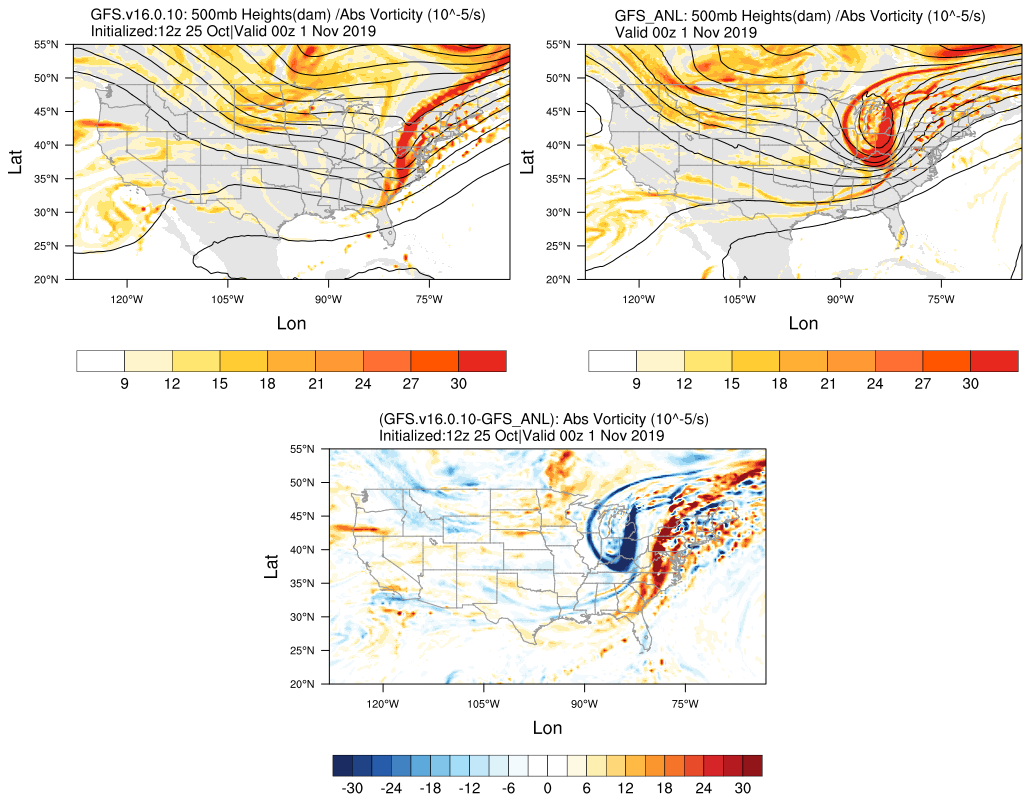
500 hPa geopotential heights (dam) and absolute vorticity (10 -5/s)
GFS.v16.0.10 generates a progressive synoptic pattern compared with reanalysis data.
The positive tilted trough in GFS.v16.0.10, versus the negative tilted trough in GFS_ANL, indicates a less severe storm over the eastern U.S.
4.2.2. Surface Temperature and Wind Speed
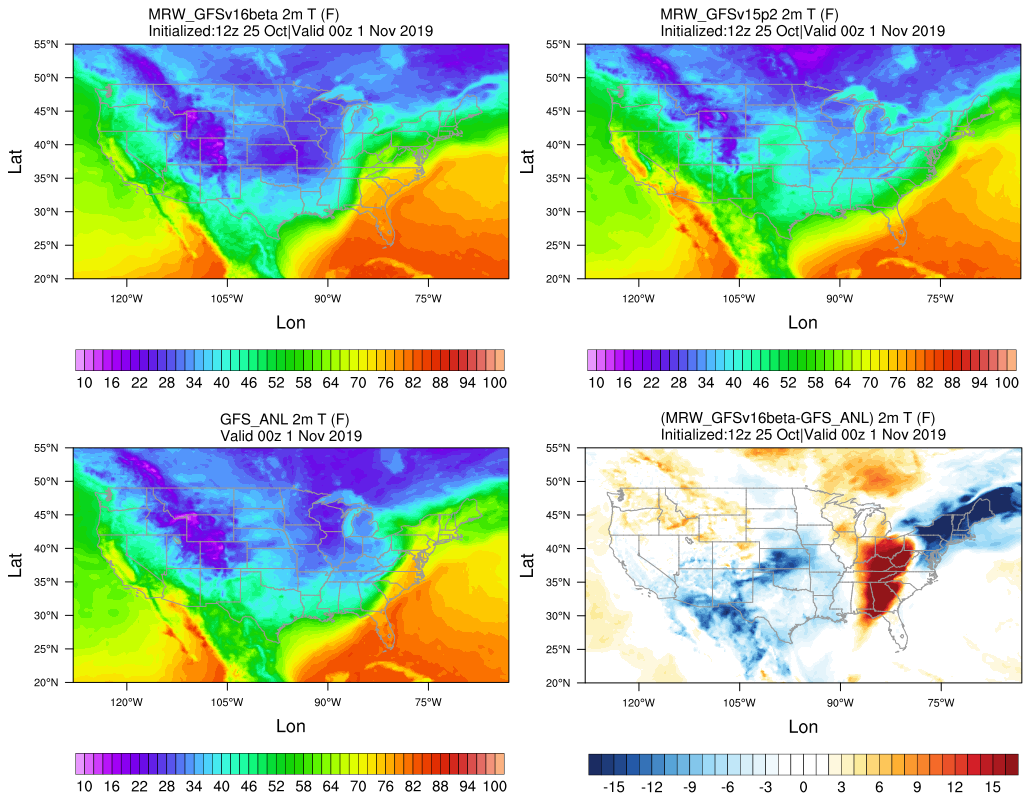
2-m temperature (F) valid at 00z 1 Nov 2019
Colder 2-m T in MRW_GFSv15p2 along the U.S. east coast compared with GFS_ANL
Colder 2-m T at New England and warmer 2-m T at the Southeast in MRW_GFSv16beta
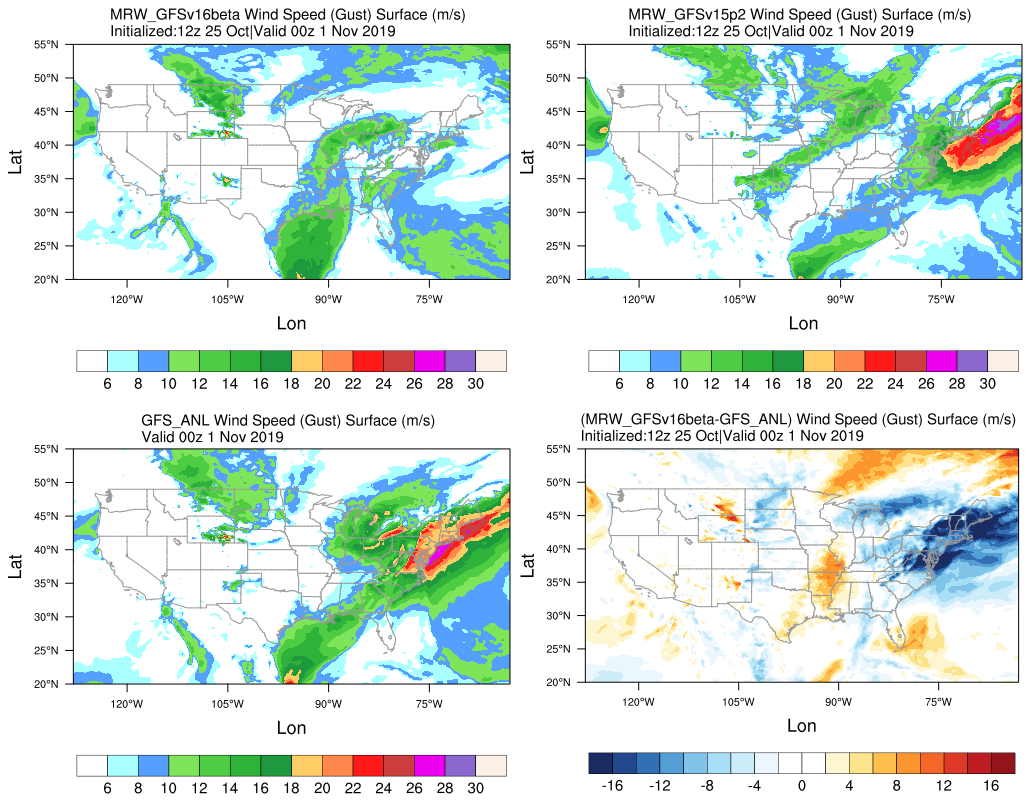
Surface gust (m/s) valid at 00z 1 Nov 2019
MRW_GFSv15p2 captures the magnitudes of surface gust as in GFS_ANL.
MRW_GFSv16beta does not reach the peak of surface gust as in GFS_ANL.
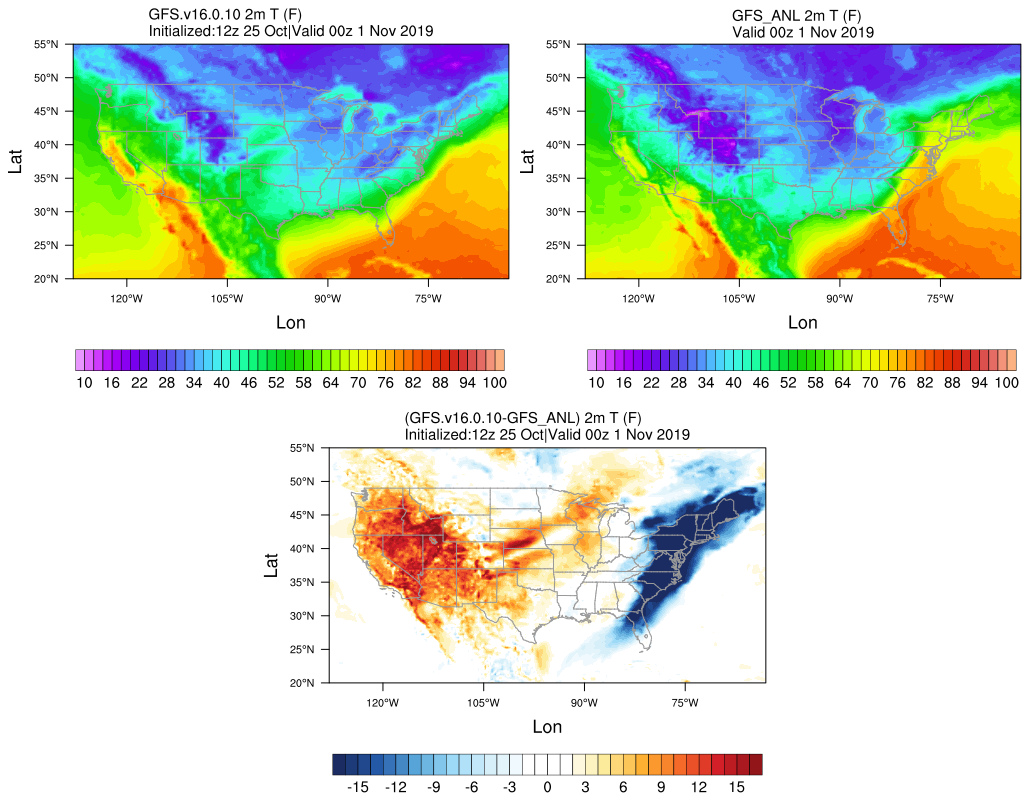
2-m temperature (F) valid at 00z 1 Nov 2019
Colder 2-m T in GFS.v16.0.10 along the U.S. east coast compared with GFS_ANL
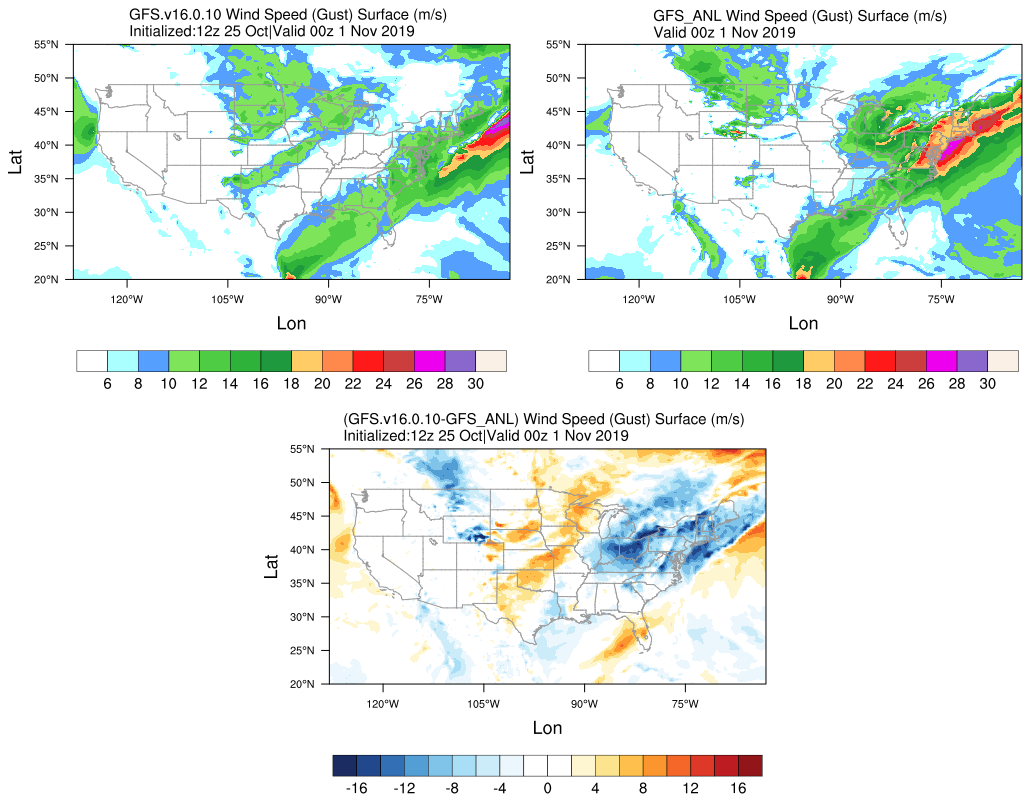
Surface gust (m/s) valid at 00z 1 Nov 2019
GFS.v16.0.10 does not capture the surface gust at the Great Lakes Region, accompanied by a faster-moving and narrower trough compared with GFS_ANL.
4.2.3. Moisture/Precipitation
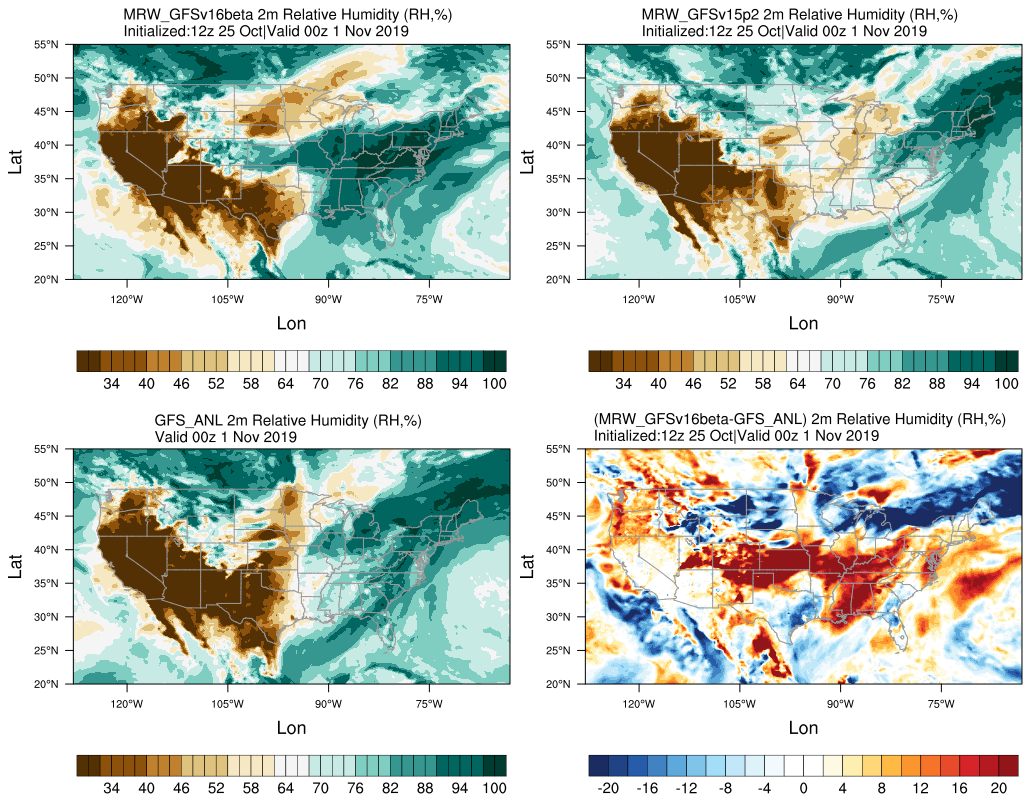
2-m relative Humidity (RH,%) valid at 00z 1 Nov 2019
Dryline across the central U.S. is not simulated well in the two physics compsets.
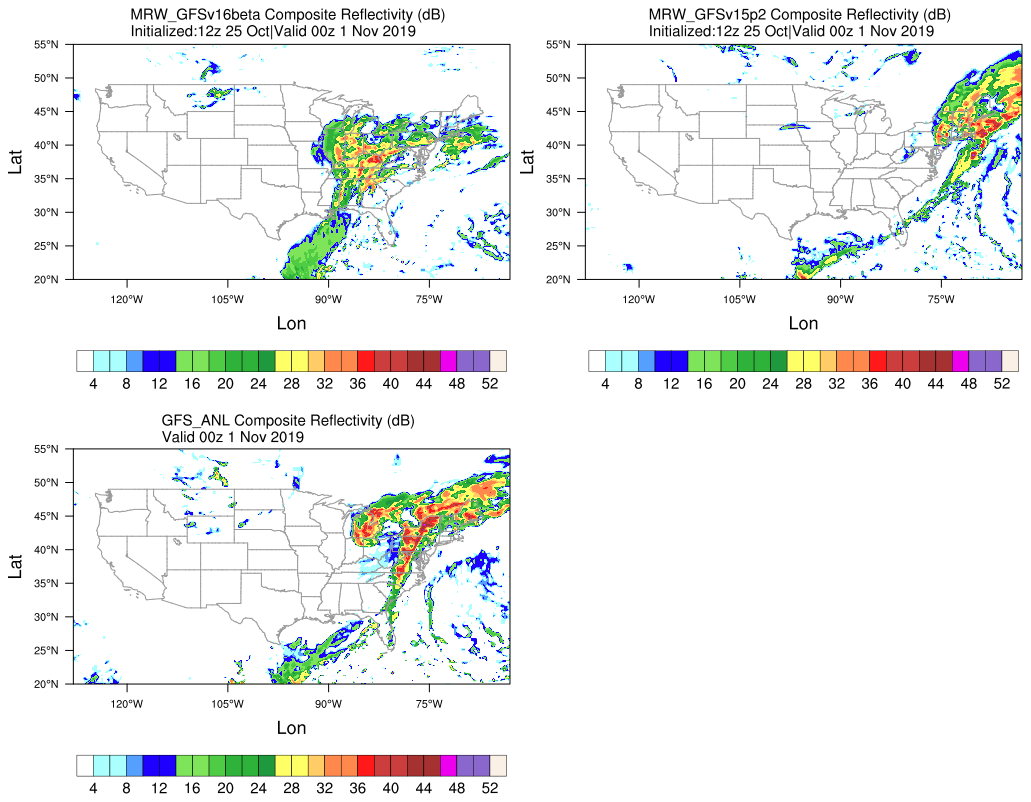
Composite reflectivity (dB) valid at 00z 1 Nov 2019
The precipitation location lags behind the MRW_GFSv16beta compared with GFS_ANL, while the precipitation location moves further northeastwards in MRW_GFSv15p2 compared with GFS_ANL.
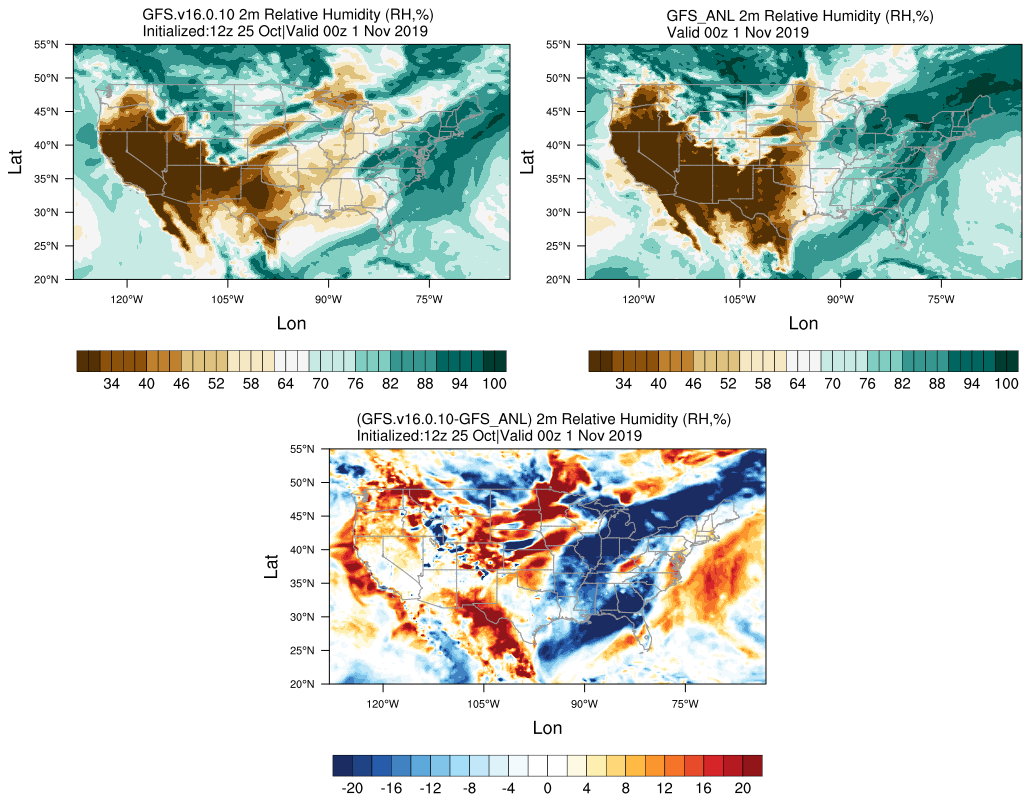
2-m relative Humidity (RH,%) valid at 00z 1 Nov 2019
The dryline across the middle U.S. blurs out in GFS.v16.0.10.
Dry bias over the Eastern U.S. and wet bias over the Western U.S.
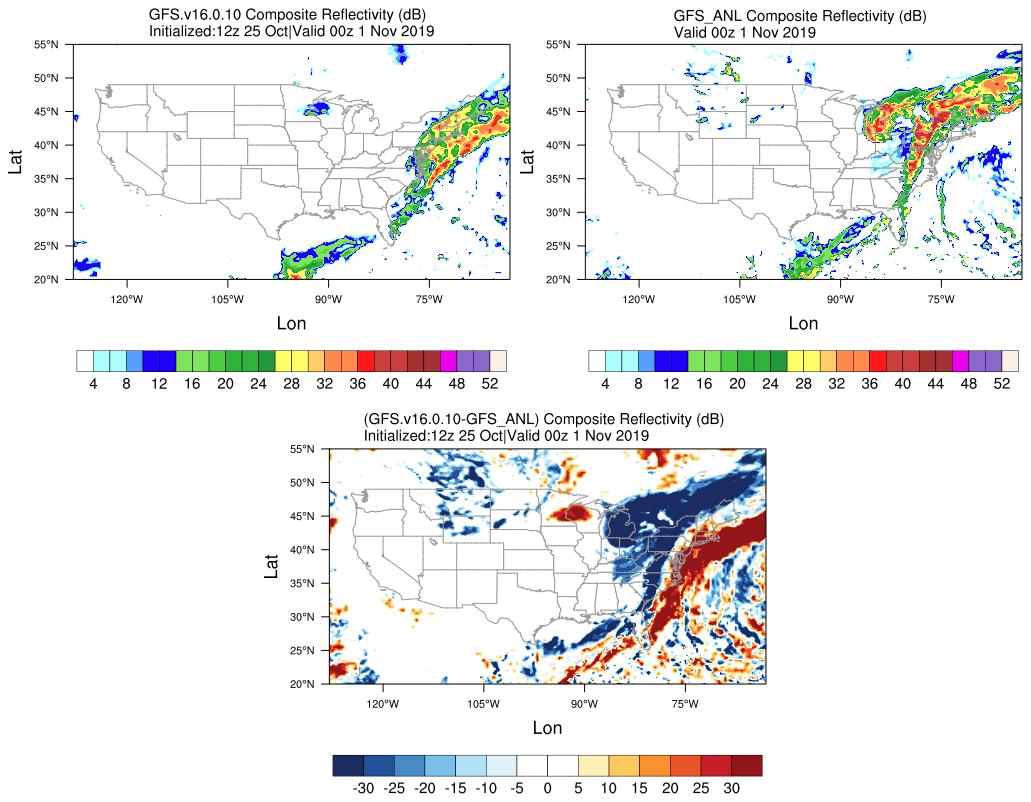
Composite reflectivity (dB) valid at 00z 1 Nov 2019
Lower composite reflectivity values suggest less intensive precipitation over the Northeastern U.S.
4.3. Summary and Discussion
MRW_GFSv15p2 generates a progressive synoptic pattern during the 2019 Halloween Storm, while MRW_GFSv16beta generates a regressive synoptic pattern compared with GFS analysis data. GFS.v16.0.10 alleviates the progressiveness of MRW_GFSv15p2 but still generates a cold bias along the U.S. east coast. Major changes in GFS.v16 from GFS.v15 can be referred to Yang (2020).
References
Yang F. (2020). Development and evaluation of NCEP’s Global Forecast System Version 16. Unified Forecast System Community Webinar, Oct 22, 2020. [Link]